
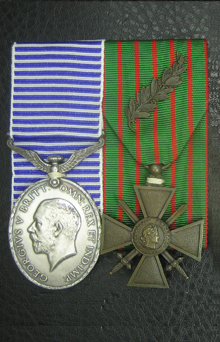
Full medal write up


DISTINGUISHED FLYING MEDAL, G.V.R. ‘113763 SERGT. HAGAN. J.C., R.A.F.’, FRANCE, THIRD REPUBLIC, CROIX DE GUERRE, THE REVERSE DATED 1914-1918, WITH BRONZE PALM ON RIBAND.
D.F.M. London Gazette 3 June 1918. Citation published 21 September 1918:
‘A gallant and skilful aerial gunner who shows the greatest keenness in his work on patrol. On one occasion he shot down an enemy machine after he himself had been wounded.’
M.I.D. London Gazette 20 May 1918
French Croix de Guerre London Gazette 17 August 1918:
John Charles Hagan, who was born in Liverpool but later moved to Ulverston, Lancashire, enlisted in the Royal Horse Artillery in January 1907. He subsequently served as a gunner in France from December 1914, transferring to the Royal Flying Corps in November 1917. Number 1 Aircraft Depot Logs confirming that on 6 November he was posted to 22 Squadron as an Air-Gunner with the rank of Air Mechanic 2nd Class.
https://en.wikipedia.org/wiki/Bristol_F.2_Fighter
Advanced to Sergeant on 7 February 1918, on 26 February 1918, Hagan was flying as Aerial Gunner to Sergeant Pilot E J Elton when the formation they were flying in was attacked by 10 German fighters. During the combat, Hagen and Elton shot down 2 of the German fighters but their own aircraft received multiple hits, one bullet wounding Sergeant Hagan:
From R.F.C. Communiques:
“Sgt E J Elton & Sgt J C Hagen, 22 Sqn, Albatros Scout crashed east of Lens at 11:30/12:30 and Albatros Scout broke up east of Lens at 11:30/12:30: Sergt E Elton and Sergt C Hagen, No 22 Squadron, whilst in formation were attacked by 10 Albatros Scouts. Sergt Hagen got a long burst into one E.A. which was diving on his machine; the pilot was seen to collapse over the fuselage and the enemy machine crashed to the ground. They then dived on another E.A. which was below, and after firing a burst from short range the enemy machine collapsed in the air and fell to pieces”
Following the engagement The Bristol fighters engine failed due to bullet hits it had received and:
“Elton glided the six miles back to the Allied lines but crash-landed in no man’s land. His observer/gunner Sergeant Hagen had been wounded in the leg, so Elton dragged him out of the aircraft and into a shell hole, then crawled and ran 200 yards to the Allied lines to fetch help. He returned with a first aid man to dress Hagen’s wounds, then sat with him until dark, when he was stretchered back to safety. The aircraft was later recovered and was found to be riddled with bullet holes, including in the fuel tank under the pilot’s seat.”
Sergeant Hagen had been severely wounded in the thigh and was initially admitted to hospital in Calais. In May he was transferred to Hospital in Bath and then for surgery in Birmingham. It appears he did not return to front line service after recovering from his wounds, however on 1 January 1919 he was reclassified as Sergeant Observer. He was finally discharged from service as medically unfit on 12 December 1919. Post war, Hagan settled at Colden, Hebden Bridge, Yorkshire, where he became a pig and poultry farmer.
As noted, Sergeant Hagen had joined 22 Squadron as an air gunner in early November 1917 and therefore had nearly 4 months active service before being wounded in action. His D.F.M. recommendation is in part is for his actions on 26 February but also points at his gallantry and skill as an aerial gunner and it is likely it was for this that he was mentioned in despatches prior to the award of the D.F.M. The reason for the award to the French Croix de Guerre is unknown but it is almost certainly linked to the award of the D.F.M. It would be worth a search of French archives, in particular the Journaux officiels of the period of the award, as this published most recommendations.
The 2 aerial victories credited to both Hagen and Elton on 26 February 1918 were the first 2 of 16 aerial victories credited to Flight Sergeant Ernest John Elton:
https://en.wikipedia.org/wiki/Ernest_Elton
Note: According to his Medal Index Card, Hagen’s 1914-15 Star which was ready for despatch in September 1922 was returned unclaimed, and his British War and Victory Medals, ready for despatch in October 1921, were likewise returned by R.A.F. Records; this additionally confirmed in his service records. Critically, there is no note to them ever being reissued.
Hagen’s Croix de Guerre was despatched in October 1919 (a month prior to his D.F.M.) whilst Hagan was still in service and this is likely why this is the only other medal he actually received and is still with the D.F.M. As Such the D.F.M. and Croix de Guerre were the only medals actually awarded to and received by Hagan and no medals are missing from the group.
It is unclear whether his M.I.D. emblem, Silver War Badge and King’s Certificate (send January and October 1920), were received or not but they likely were as unlike the medal trio, they are not noted as returned.
Condition GVF, mounted for display. Sold with Service papers, MIC’s etc (digital). Ex DNW 2001.
An extremely scarce award with just 104 awards of the D.F.M. being made in the Great War, of these just a small number awarded to aircrew in fighter squadrons. Here was not only have a D.F.M. but a M.I.D. and French gallantry award.