
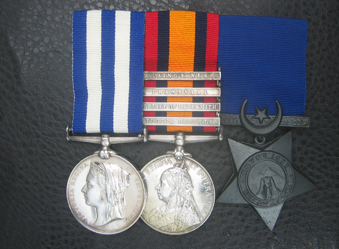
Full medal write up


EGYPT AND SUDAN 1882-89, UNDATED REVERSE, NO CLASP ‘F. W. MELVILL, MIDN. R.N. H.M.S. “MINOTAUR”’, QUEEN’S SOUTH AFRICA 1899-1902, 4 CLASPS, TUGELA HEIGHTS, RELIEF OF LADYSMITH, TRANSVAAL, LAING’S NEK ‘LIEUT: F. W. MELVILL, R.N. H:M:S FORTE’; KHEDIVE’S STAR, DATED 1882.
Francis William Melvill was born in Brompton, Middlesex on 16 April 1867, and entered the Royal Navy as a Cadet in Britannia in July 1880, aged 13. His first seagoing appointment was in as a Midshipman in the Minotaur, in which he served off Egypt in 1882. Among other notable appointments in the 1880s, he served in the Alexandra, flag ship of the Mediterranean Fleet, flying the flag of Vice-Admiral H.R.H. The Duke of Edinburgh. Advanced to Lieutenant in April 1890, Melvill went on to serve on the North America and Pacific stations and was given his first command, the gunboat Heron, in September 1897. During his tenure of command in the following year, ten of his crew were landed for operations on the Niger River.
As it transpired, Melvill, too, would shortly see service as a bluejacket, for, in October 1899, he was appointed First Lieutenant of the cruiser Forte on the Cape of Good Hope station. Hostilities having by then commenced in South Africa, he was landed as second-in-command of the Naval Brigade under Captain E. P. Jones, R.N., in which, among other operations, he was present in the battle for the Tugela Heights and at the relief of Ladysmith. In the former engagement, on 23 February 1900, Melvill had charge of the Naval Brigade’s 12-pounder unit, which was placed on a high kopje. There, in common with the 4.7-inch and 5-inch naval guns, it came under heavy fire:
‘During the whole day the enemy shelled very vigorously, and it is beyond my comprehension how so small amount of damage was done, as they were shooting with great accuracy.’
In his despatch to General Buller on 14 June 1900, Captain Jones also reported that Melvill was ‘indefatigable in his work’ in selecting positions for the naval guns at Van Wyck, whilst in Buller’s despatch dated 19 June 1900, he was cited for his ‘good service’ in the engagement at Allemann’s Nek on the 11th. Moreover, he was specially promoted to Commander in October 1900.
On departing Forte in January 1901, he held a succession of appointments in the Channel Squadron, among them the battleship Illustrious. And it was during that appointment that tragedy struck on his taking the helm of the ship’s steam pinnace off Weymouth on 2 October 1903. He lost his footing and fell overboard. As reported in The Times, it was very dark night with strong winds and a heavy sea and although every effort was made to rescue him, he was pulled down by the weight of his uniform and a heavy coat. In writing to The Times, Vice-Admiral Lord Charles Beresford stated that:
‘Commander Melvill's death had cast a gloom over the whole Channel Fleet. He was a much respected officer and the service has lost a brilliant and most popular officer.’
Condition GVF, Egypt issued circa 1884, with copy research including record of service. Ex Alan Hall Collection, June 2000.
A unique bluejacket’s group, the recipient was the only naval officer to receive this clasp combination.